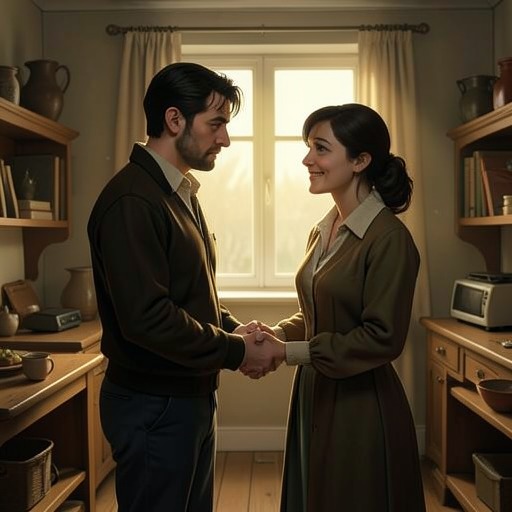
David Zetterberg and Eva Zetterberg’s marriage and partnership
Handling the UndeadDavid Zetterberg and Eva Zetterberg’s marriage is defined by affectionate routine and David’s abiding gratitude, then tested by the difference between Eva’s living presence and her return as one of the reliving. The relationship’s decisive change comes at the hospital: David’s insistence that he cannot live without her meets first with a hand that squeezes back, then with a wife whose body is present but whose eye seems empty and whose grip has become mechanical.
Everyday Partnership
After ten years of marriage, David still looks at Eva and feels that he has been extraordinarily lucky. His sense of their life together does not depend on uninterrupted happiness: he acknowledges black days and even weeks without joy, but understands his gratitude as something that survives those periods and returns into view. The relationship is thus presented not as an unbroken ideal but as an enduring attachment through the less joyful parts of married life.
Their affection appears in small domestic gestures. When Eva comes home from work, David greets her in the hall, kisses her, and asks how she is. She answers that she is mostly fine, though she has a headache, then turns her attention to his writing and asks whether he has been able to work. David gestures toward his desk and admits that the material is not very good; Eva asks whether she can hear it later. Her interest is gentle rather than grand: she makes room for his work while he makes room for her tiredness and ordinary arrival home.
Their creative lives offer a further point of comparison. Eva edits and illustrates nonfiction books for children at the small publishing company Hippogriff and has written and illustrated two books about Bruno, a philosophically inclined beaver who likes to build things. She jokes about the uncertain appeal of the books to children, while David considers them funnier than his own monologues. The comparison gives their intimacy a teasing, observant quality: each has a creative practice, and David’s private judgment of Eva’s work is more generous than his judgment of his own.
Marriage as Family Life
David and Eva’s partnership also takes shape in how they arrange care for Magnus. On the evening they plan to spend apart, Magnus is to sleep at David’s mother’s home while Eva visits her father, with the expectation that she will return in the middle of the night. They pick Magnus up together, and all three kiss. The scene makes separation temporary and coordinated: each parent has a separate destination, but the family’s affection is enacted together before they part.
The farewell is threaded with familiar, lightly teasing conversation. David warns Magnus not to watch too much Cartoon Network at his grandmother’s; Magnus says he no longer watches it, and Eva responds. Their exchange does not announce the catastrophe to come. Its significance lies in its ordinariness: David and Eva remain a couple sharing the small work of parenting, and the night’s plans assume that they will meet again.
Death and David’s Appeal
That expected return is shattered when Eva collides with an elk and dies before David reaches the hospital. Her heart stops at 22:36. At her bedside, David understands her death as the collapse of both their imagined future and their shared past. He falls to his knees, takes her hand, and repeats that it cannot be happening and that he cannot live without her. The language of their marriage becomes, in that instant, a plea against its ending.
David’s repeated words begin to feel like a possible means of changing what has happened. He keeps talking until he has nearly convinced himself that continuing to insist will make a miracle occur. When Eva’s hand jerks and squeezes his, he does not shout or move; he stares at the hand and presses it, and it presses back. The response gives him a physical sign of contact at the precise moment when death seemed to have made contact impossible. His wedding band, drawn across his skin as he rubs her hand against his forehead, also places the marriage’s familiar symbol inside this radically changed scene.
Return and Altered Intimacy
The hand’s answering pressure does not settle what Eva’s return means. Later, at 23:07 in Danderyd Hospital, David approaches the bed while facing the possibility that his wife has become frightening to him. He makes himself step closer because she is his wife, but her eye appears covered by a thin grey membrane; he reads it as evidence that she is not present in the way he remembers. The intimacy between them must now contend with a body that is recognizably Eva and yet gives him no familiar look in return.
When David strokes her cheek, Eva’s hand rises quickly and grips his with painful force. He identifies himself and tells her that he is there. Her grip is stiff and mechanical, and her eye still seems empty to him, but she tries to form his name. After a pause, she manages a broken version of “David.” He takes this effort as evidence that she understands and tries to establish their identities in simple terms, pointing to himself and saying that he is David and she is Eva.
The relationship is left suspended between recognition and estrangement. Eva’s hand had once squeezed back as an intimate answer; now it can hurt him without conveying the tenderness that gesture had seemed to promise. Her attempt to say his name offers a fragile point of connection, but the scene does not restore the ordinary mutual life that their marriage had held. Instead, their bond becomes the ground on which David approaches and tries to recognize the returned Eva, even when her body’s signs of presence cannot guarantee the person he remembers.